Nissan Qashqai review
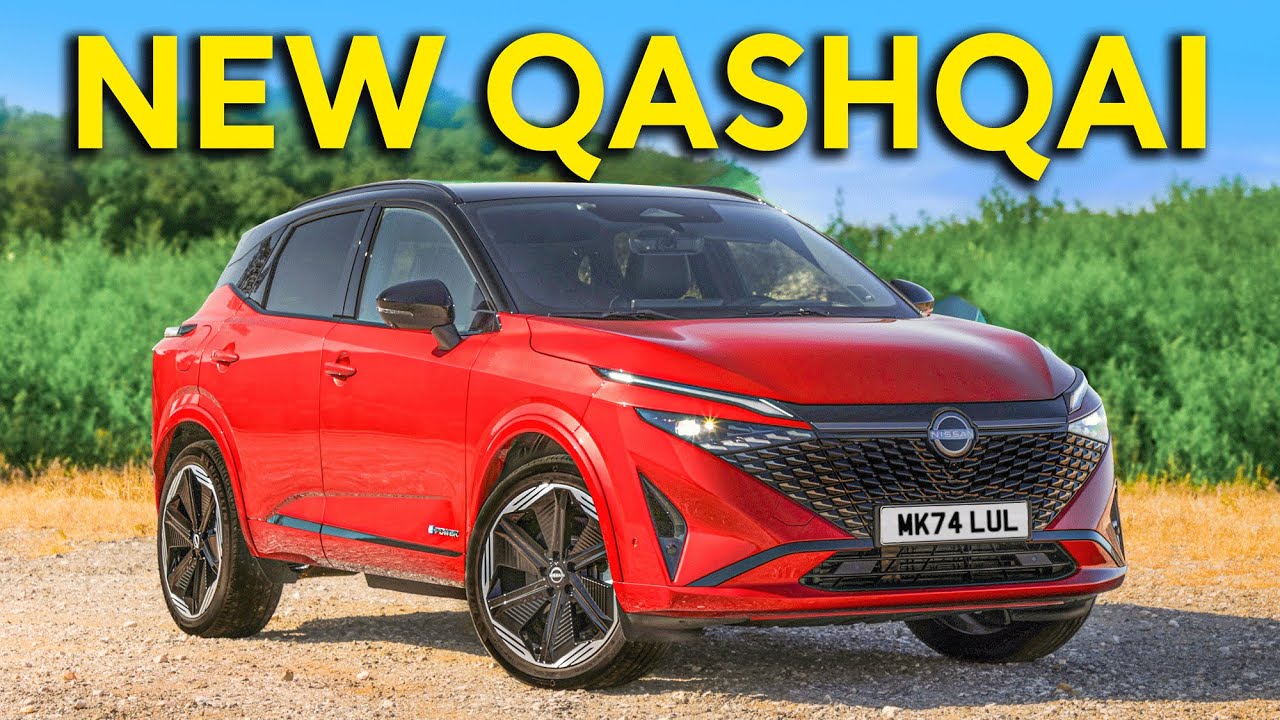
The Nissan Qashqai is one of those cars that needs very little introduction. But does the SUV that kick-started Britain’s love of family crossovers still have what it takes to dominate the market two decades later? Read our facelifted Nissan Qashqai review to learn more.

)
Pros
- e-POWER is one of the world’s better hybrids
- Sensible layout with plenty of buttons
- Familiar driving experience
Cons
- Most SUVs have bigger boots
- Warranty is only average
Interior
Our rating: 8/10
Driving position
Although the Nissan Qashqai is a mid-sized SUV/larger crossover, the seating position has a lot more variability in it than others.
We found the position to be fairly low and pretty far back from the windscreen, making the Qashqai feel bigger than it is. But you can, of course, jack the seat up for a more commanding view.
On the whole, we think it feels more car-like than some other family SUVs.
The slim A-pillars are notable, because they really help when pulling out at junctions and roundabouts.
The large rear windscreen is also framed perfectly by the rear-view mirror, further helping to minimise blind spots.
Tech and features
Nissan Qashqai trim levels
– Acenta Premium
– N-Connecta
– N-Design
– Tekna
– Tekna+
Acenta Premium is where the range kicks off, and you get a 12.3-inch touchscreen, a reversing camera, dual-zone climate control and wireless Apple CarPlay/Android Auto.
Compared with previous generations of Qashqai, and even the pre-facelift model sold between 2021 and 2024, this is a really strong starting point.
As you move up through the trim levels, you gain extras like wireless phone charging and bigger alloy wheels, but we think Tekna is a good option for high specifications.
It adds a panoramic sunroof, a head-up display, a powered boot lid, heated front seats and a heated steering wheel.
Our top-spec Tekna+ test car came fitted with quilted leather upholstery, front massaged seats and a BOSE sound system, but these are nice-to-haves rather than essentials.
Key to the Qashqai, across the range, is the Google-based navigation, which works well and is up-to-date with locations and points of interest.
And unlike many other SUVs, there’s no on-screen climate control to talk of. It’s all handled through a full suite of physical controls.
Some may call it nostalgic. We call it sensible. This is by far the easiest way to quickly make temperature changes on the go.
However, the Qashqai’s cabin does feel a little more cluttered than some other family SUVs like the Volkswagen Tiguan and even the all-electric Nissan Ariya.
There are lots of buttons on the dash and steering wheel, and the digital instrument cluster shows a lot more information than is absolutely necessary (which is nice to have if that’s your style).
Performance
Our rating: 8/10
Engines and power
Nissan Qashqai performance stats
– Power: 140 to 205hp
– 0-62mph: 7.6 to 10.2 seconds
– Top speed: 105 to 128 mph
– Driven wheels: Front-wheel drive
All models are available with either mild hybrid petrol power or Nissan’s legendary e-POWER, so there’s no holding back the best options for the highest trim levels. Nice to see.
The 1.3-litre mild hybrid either comes with either 140hp and a manual gearbox, or 158hp and an automatic gearbox. Naturally, the more powerful version is quicker to 62mph, by a whole second.
It uses a CVT instead of a conventional automatic gearbox. It’s the smoothest type of automatic there is, but it can get quite noisy under acceleration, because it revs highly.
Our test car had the new and improved e-POWER setup. In August 2025, it got uprated to 205hp from 190hp.
In theory, it’s a type of hybrid, but it’s far more similar to an electric car because the 1.5-litre petrol engine never, ever drives the wheels. It only recharges the battery on the go, making it more of a range-extended EV.
This one does 0-62mph in 7.6 seconds when in Sport mode, or 7.9 seconds when it’s in other drive modes because power is limited to around 190hp.
Handling and ride comfort
Because it’s only the 205hp electric motor that drives the wheels through a single-speed gearbox, just like most EVs, it feels much quicker than the petrol version.
You can change between ‘D’ and ‘B’ modes for additional regenerative braking if you prefer to slow down without excessive brake pedal use, and there’s also a button for Nissan’s e-Pedal mode.
The whole driving experience is a real pleasure, and we’ve been equally impressed by the 1.3-litre petrol, which is used in other cars within the Renault-Nissan-Mitsubishi Alliance.
Certain potholes do feel slightly jarring, particularly over the front axle, but that was the same with the Kia Sportage, which we tested in the same location just a few weeks prior.
Another reason you might want to go for an updated 2025-onward model is for higher refinement – it’s up to 5.6dB quieter, which is quite a difference.
Practicality
Our rating: 6/10
Boot space
Nissan Qashqai boot space
– Boot space: 455 to 504 litres
– Incl. Rear seats folded: 1,379 to 1,447 litres
Boot space varies by far more than just engine choice – even trim levels influence how much room you’ll get because speakers and subwoofers occupy some space.
You get 455-504 litres across the board, and the e-POWER model doesn’t actually suffer despite the bigger battery.
Fold the seats down for over 1,379-1,447 litres of space.
The boot is plenty big enough, and a false floor helps keep the loading area flat if you need to slide things in and out with ease.
But it’s not the last word in practicality. The Kia Sportage has up to 591 litres in petrol form, and the VW Tiguan has an even bigger 652-litre space.
In summary, it’s not class-leading, but it’s perfectly adequate for family life.
Rear seats
Space in the back of the Qashqai is good, and there’s plenty of headroom and legroom, even for adults. The bench is comfortable, but the seat base could be just a tad deeper for taller passengers.
Thankfully, the rear doors open really wide, so fitting child seats should be easy.
The flat floor also makes the middle seat more usable than in some other cars, but it’s still the narrowest seat in the house.
Storage solutions
Some of the headline storage solutions include deep door bins, multiple cupholders, a wireless phone charging pad and a well-sized centre console area.
Nissan doesn’t make the same bold claims as some other manufacturers about how many litres of storage there are inside the cabin, but it’s pretty much got you covered.
Nissan Qashqai dimensions
– Height: 1,625mm
– Width: 2,084mm (incl. mirrors)
– Length: 4,425mm
– Weight (kerb): Up to 1,660kg
Safety
The Qashqai was tested by Euro NCAP in 2021 when this generation was launched, and it got a full five stars. A 2025 test for the facelifted model resulted in a reduced four-star rating, but it’s not all that it seems.
Nissan hasn’t made the Qashqai any less safe (in fact, the opposite) – testing procedures have just become stricter, and the bar is even higher.
Autonomous emergency braking (AEB), lane-keep assist and traffic sign recognition are all standard affairs, and the ProPILOT driver aids add adaptive cruise control and lane centring on higher specifications.
Running costs
Our rating: 9/10
Fuel economy
Per Nissan’s claims, the e-POWER model is 15% more efficient and 12% less polluting.
Officially, you’ll get 62.8-64.2mpg from the e-POWER, but it depends how you use it, the length of your trip and your average speed. In our experience, we got anywhere from 40mpg to around 55mpg.
Petrol versions claim around 44.1-45.6mpg and there’s barely any difference between manual or automatic.
All models have a 55-litre fuel tank, so if you’re doing longer trips and want to stop less, e-POWER is definitely the way to go.
Reliability
Nissan’s warranty is nothing more than the industry average, at three years/60,000 miles.
Still, there is some comfort in the fact that the 2025 update increased the e-POWER model’s servicing requirement by 3,000, from 9,000 miles to 12,000 miles.
The verdict
Interior
8/10
Performance
8/10
Practicality
6/10
Running costs
9/10
The Nissan Qashqai remains one of those family cars that’s easy to recommend. It focuses on the things that matter most in an SUV – space, efficiency and day-to-day liveability.
Where the Qashqai really stands out against all of its rivals is with the impressive e-POWER setup, which drives like an EV without any of the drawbacks.
Real-world fuel economy might vary, but it’s still got enough kick to make other self-charging hybrids worry (and they’re never as slick to drive).
Boot space is far from class-leading, and it doesn’t offer the most digital-first interior, but if you just need something familiar, it’s hard to go wrong.
Similar to the review