Fiat 500 Hybrid review
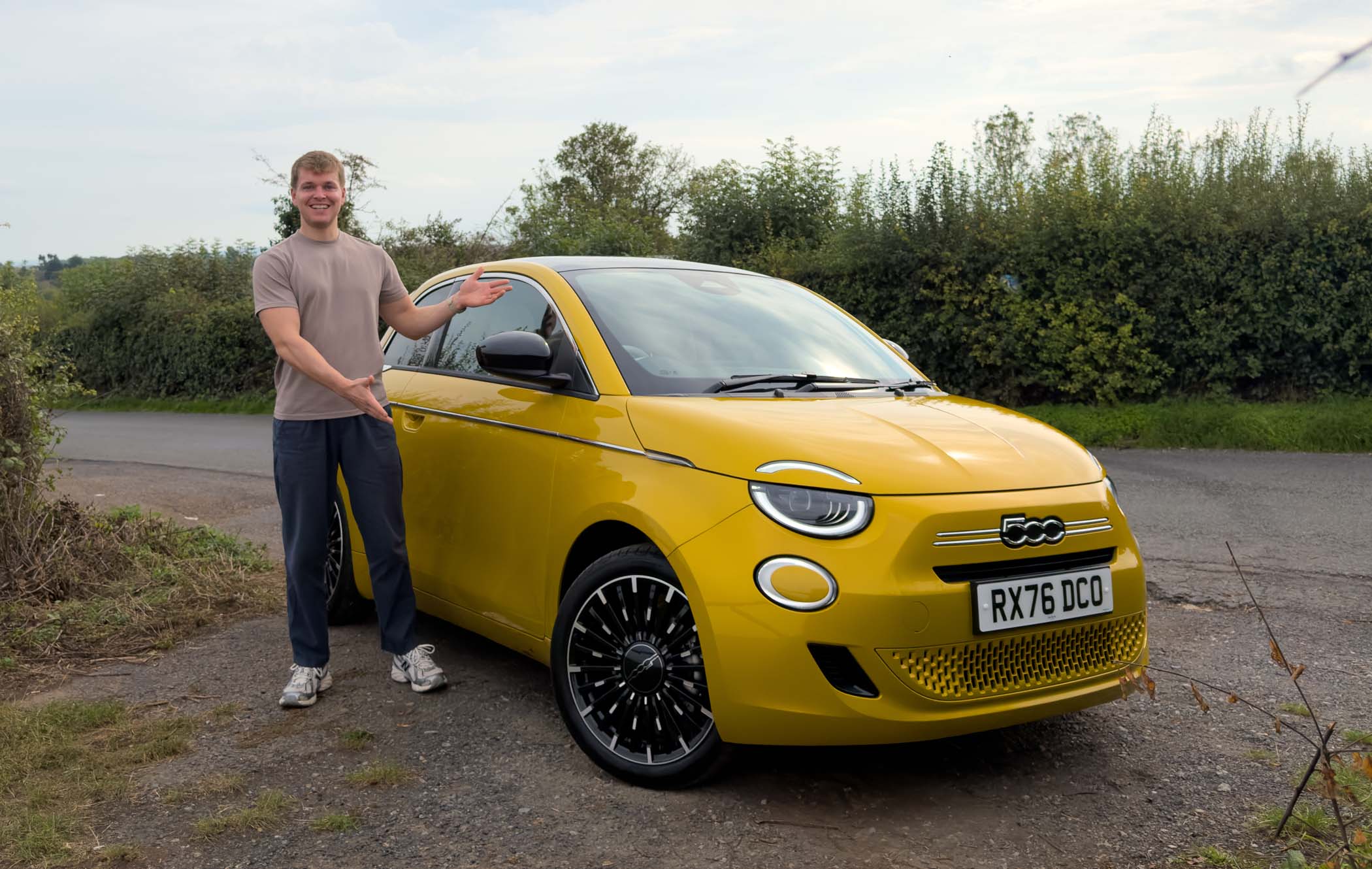
What happens when a manufacturer turns a dedicated electric car into a petrol model? We find out whether fitting an engine and fuel tank impacts the Fiat 500 Hybrid’s packaging and how performance compares with the all-electric 500e. Read our full Fiat 500 Hybrid review to find out more.


Pros
- Iconic design, near-identical to Fiat 500e
- Ergonomic cabin with physical controls
- Outstanding fuel economy
Cons
- Painfully slow outside of town
- Rivals have more rear-seat space
Interior
Our rating: 8/10
Fiat landed on the perfect formula when it reinvented the Fiat 500 in 2007, then when the electric model landed in 2020 it felt even more worthy of its place in the city car market.
It was always a shame that the petrol/hybrid model didn’t get re-launched, but six years later and in response to buyer demand, Fiat finally added mild hybrid petrol power to the modern 500.
One of the biggest challenges carmakers had when the world went electric was fitting huge batteries under the floor in cars that already existed, and that would often lead to poor interior space configurations.
For the Fiat 500, it was the reverse. The engineers had to fit a bulky engine and fuel tank in a car that was primarily designed to be electric.
Driving position
Thankfully, you can’t tell from inside, where it feels almost identical to the electric model. We’re talking about the same seating position, floor height and steering adjustment – all good news, then.
But like that car, rearward visibility isn’t quite as good as forward visibility because of the rounded roofline and chunky C-pillars.
Taller drivers may find the fairly high seating position, limited seating adjustment (four-way in Icon and six-way in La Prima) and compact footwell a bit cramped, but compared with other compact hatchbacks, the 500 actually feels pretty airy.
Especially with the non-opening sunroof on La Prima models, which floods the tiny cabin with natural light.
Tech and features
Fiat 500 Hybrid trims
– Icon
– La Prima
Fiat decided to keep things simple in the 500 Hybrid with just two trim levels – Icon and La Prima. But with the latter accounting for around four in five new sales, the brand didn’t really need to launch as many trims as it did in previous models.
Every model gets a 10.25-inch touchscreen that sits on top of the dash, but because it’s pretty squat and wide, it doesn’t take up precious windscreen space.
It’s not the most feature-packed screen by today’s standards, but we’ll let it off because it has wireless Apple CarPlay/Android Auto and it’s responsive enough for most needs.
Fiat insists it resisted the temptation to go button-less, and for that we’re thankful.
There’s a row of shortcut climate controls under the screen, which we used and appreciated, and the steering wheel’s also got plenty of easy-to-use physical buttons.
All models come with rear parking sensors and cruise control, plus a seven-inch driver's display.
It might be fully digital now, but the main view is still a simplistic, circular speedo reminiscent of its predecessor and the original Fiat 500 of 1957, which we love.
The popular La Prima spec adds a JBL speaker system, wireless phone charging, keyless entry and heated front seats, so it’s easy to understand why this one’s the most popular one. You also get a reversing camera.
Performance
Our rating: 6/10
Engines and power
Fiat 500 performance stats
– Power: 65hp
– 0-62mph: 16.2 seconds
– Top speed: Up to 93mph
– Driven wheels: Front-wheel drive (FWD)
The Fiat 500 Hybrid comes with just one engine – it’s a 1.0-litre, three-cylinder petrol engine with a small 12V starter-generator, making it a mild hybrid.
Unlike some more sophisticated mild hybrids, including the ‘1.2 Hybrid’ Fiat uses in the bigger Fiat 600, this mild hybrid system is just designed to keep essentials like your air-con and radio running for longer periods at a standstill.
Think of it as an advanced stop-start system, which will also cut out below around 16mph in our testing if you come to a standstill in neutral with your foot off the clutch.
It uses a six-speed manual gearbox which feels excellent to use, with short shifts and a gearstick that’s conveniently placed high on the dashboard like the older Fiat 500.
But there is an elephant in the room, and it’s the 65hp power output. 0-62mph in 16.2 seconds feels more like three to five business days, and if you take it anywhere beyond the 20mph and 30mph limits of town, it struggles.
Hilly country lanes and motorway slip roads are the Fiat 500 Hybrid’s enemy, and if you’re likely to be travelling at higher speeds, the all-electric Fiat 500e might be more appropriate.
The 500C Hybrid, with its heavier fabric roof option, takes an even longer 17.3 seconds to get to 62mph.
Still, around town it feels responsive enough and the thought-out gearing lets you glide around in an efficient, high gear – and in near silence.
Handling and ride comfort
65hp isn’t necessarily a bad thing, though, because it means you can enjoy all of the car’s power nearly all of the time.
You’ve really got to work for your acceleration, and it feels every bit as engaging as a hot hatch.
It’s helped by the Fiat 500 Hybrid’s short wheelbase, which keeps it feeling nimble and predictable around tight bends.
Steering is light around town, but unlike older models which had a 'light steering’ button, this model is light all the time.
We’d maybe like a bit more weight at higher speeds to instil a bit more confidence – especially as you’ll likely already be preoccupied with making sure you’re in the right gear for those upcoming hills.
Practicality
Our rating: 5/10
Boot space
Fiat 500 Hybrid boot space:
– Boot space: 183 litres
– Incl. rear seats folded: 440 litres
Boot space is largely unchanged – with 183 litres of space, it does lose two litres of room compared with the older model (and the 500e on which it’s based), but it’s nothing you’ll ever notice.
Rivals like the Kia Picanto (255 litres) and Hyundai i10 (252 litres) have considerably more space, but for the weekly shop, the Fiat 500 Hybrid will suffice.
Rear seats
Technically, the Fiat 500 Hybrid is a four-seater, but you’ll be unlikely to want to ride in the back for too long.
Being a three-door car, access through the long front doors is awkward.
Interestingly in Europe, the electric Fiat 500e comes with a so-called 3+1 option, which includes one single rear door on the passenger side, à la Hyundai Veloster.
It’s rear-hinged, much like the BMW i3 and Mazda MX-30's rear doors, and requires the front door to be opened first.
But because Europe is a left-hand-drive (LHD) market, it would mean Fiat having to re-engineer a new set of doors specifically for the UK, which is unlikely to happen unless enough buyers demand it.
Side note – the 500 Hybrid itself was a response to customer demand, so who knows?
Storage solutions
There’s not much car in which to house storage options, but it’s still positive news, starting with the phone tray under the screen (with wireless phone charging on top-spec models).
La Prima also adds a decent front armrest that's well-padded and of decent width. It’s not really an afterthought, as was the case with the optional armrest in the Renault Zoe.
Fiat 500 Hybrid dimensions
– Height: 1,532mm
– Width: 1,878mm (incl. door mirrors)
– Length: 3,631mm
– Kerb weight: Up to 1,092kg
Safety
Standard equipment includes six airbags, autonomous emergency braking, traffic sign recognition and rear parking sensors.
It’s also got the obligatory driver attention monitoring sensor, but unfortunately, it’s a bit of an eyesore – an unsightly camera bolted onto the A-pillar next to the driver.
Other manufacturers have done a better job at blending it into the design a bit better, usually peering at you from behind the steering wheel.
The 500 Hybrid has not yet been tested by Euro NCAP, but the 500e received a four-star rating in 2021, which is respectable.
Running costs
Our rating: 7/10
Fuel economy
– MPG: 53.3mpg (claimed)
The Fiat 500 Hybrid remains a truly cheap-to-run car, achieving a claimed 53.3mpg. In our testing across more than an hour of mixed driving, we managed to get exactly this.
Of course, lots of stop-start driving will lessen efficiency even despite that mild hybrid system, because it doesn’t help you set off from a standstill with electric-only driving.
Reliability
Despite being a new car, it’s also well-tested. The broader Fiat 500e design has already proven to be a hit, and the engine itself has been used before.
In fact, Fiat boasts that only 0.3% of customers have ever recorded problems with the 1.0-litre ‘FireFly’ engine, and the relatively simple mild hybrid system should help it keep that reputation.
Fiat’s warranty is an industry-standard three-year/60,000-miles, but the first two years are unrestricted by mileage.
The verdict
Interior
8/10
Performance
6/10
Practicality
5/10
Running costs
7/10
The Fiat 500 Hybrid is neither the quickest, roomiest or most hi-tech city car, but it does have stacks of heritage on its side, and the latest Hybrid model draws heavily on that with a mix of screens and buttons inside, and an instantly recognisable design outside.
For city drivers, it makes total sense. Light steering makes turns easy and the six-speed manual gearbox feels smooth to use.
Mild hybrid power also keeps fuel economy strong in an environment that would otherwise be bad for petrol engines – stop-start traffic.
Take it onto faster roads and it starts to show its flaws, not least the lack of power. With just 65hp and one of the slowest 0-62mph times in the market, it won’t be breaking any records.
Its biggest problem doesn’t come from external competition, though – it’s its own electric sibling, the 500e.
The cheapest model only costs around £2,000 more when new, it's much quicker (95hp with 0-62mph covered in 9.5 seconds) and gives you access to even lower running costs if you can live with the admittedly much shorter (118-mile) range.
Similar to the review